Date: 2026.10.08 Click: 26
A used plastic bag making machine saves money only for small, low-volume, or short-term jobs. A new machine wins over time with lower running costs, less downtime, and better automation. In 2026, you face a real question: which choice gives lower total cost, better reliability, and stronger long-term ROI? Your plastic bag business depends on this choice. A used plastic bag making machine carries hidden risks. A new one costs more money upfront. Smart buyers compare total cost of ownership, efficiency, financing, and business fit. Whether your machine is new or used shapes your business plan for years. Choosing the right plastic bag machine starts with honest numbers. This guide gives you a clear decision rule.
Key TakeawaysCompare the full cost across five years. Do not trust the price tag by itself. Energy, upkeep, downtime, and resale value pick the winner.
Used machines have hidden costs like repairs, old controls, and downtime. These costs wipe out the savings from the low purchase price within the first year.
New machines give lower costs, less downtime, better automation, tax breaks, and easier loans. These perks help long-term profit and reliability.
Pick new machines for making lots of common bags. Pick used machines if your budget is small, your runs are short, or your orders are special. Match the machine to your production plan.
Smart buyers don't just look at the price tag. You need to figure out the full five-year cost of owning the machine. This number covers the machine price, shipping and customs, setup and training, yearly energy, yearly supplies, expected downtime cost, and spare parts. Compare two quotes using the same output assumption. The machine with the lower five-year total usually wins, even if it costs more to buy at first.
A used plastic bag making machine often costs less at the start. That lower price draws in buyers watching their budget. But you have to add shipping, customs, and setup to both choices. Ask if commissioning, an on-site engineer, and operator training are included. A new machine usually comes with these services. A used one often does not.
Delivery time also matters. Sea freight and customs clearance push back your first sale. Every week without production means a week without income. Think about this timing in your total cost before you decide.
Ongoing costs tell you which deals are good and which are bad. A 10–20 kW gap in installed power turns into a monthly cost you always pay. You must count heaters, blades, photocells, and filters in your energy budget. Ask for rated power draw and energy use per 1,000 bags, not just motor power.
Maintenance schedules are different too. Ask for a five-year consumables schedule with part numbers and replacement intervals. Bearing type and warranty terms affect what you spend over time. A cheap machine that breaks often and waits long for parts kills your margin. Three weeks of downtime can erase a 5% price saving.
Resale value is better with new equipment. Used machines lose value faster and draw fewer buyers. New machines hold their value better over five years.
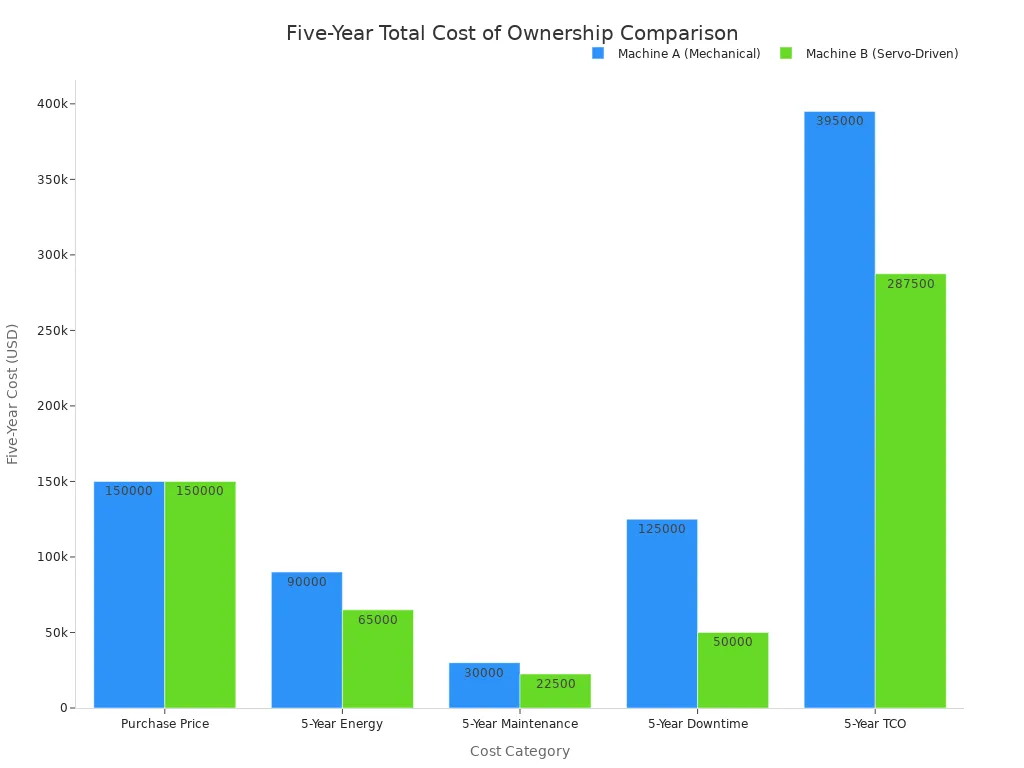
The table below shows why the purchase price by itself fools you.
|
Cost Category |
Machine A (Mechanical) |
Machine B (Servo-Driven) |
|---|---|---|
|
Purchase price |
$150,000 |
$150,000 |
|
Annual energy |
$18,000 |
$13,000 |
|
Annual maintenance |
$6,000 |
$4,500 |
|
Annual downtime cost |
$25,000 |
$10,000 |
|
5-Year TCO |
$395,000 |
$287,500 |
Both machines cost the same upfront. Machine B saves over $100,000 across five years. That gap comes from energy, maintenance, and downtime alone.
To run this comparison on your own, map out your production schedule first. Count shifts per day, days per year, and changeovers per shift. Then estimate downtime cost by figuring out lost margin per hour. Ask for mean time between failures and mean time to repair. Build a spreadsheet with columns for each cost category. Compare two or three machine options side by side.
This approach works for any bag making machine, whether you run a film blowing machine alongside it or not. The plastic bag manufacturing process rewards buyers who plan for maintenance and support costs from day one. Your business does well when you treat machinery as a five-year investment, not a one-time purchase.
Hidden Costs of a Used Plastic Bag Making Machine
The listed price hides the real danger. A used plastic bag making machine looks like a good deal on the sales listing. Then the repair bills show up. You pay for parts, labor, and lost production. These hidden costs often wipe out your upfront savings.
Older equipment breaks down more often. Belts crack, bearings seize, and heaters burn out. Each failure stops your line. You also face a bigger problem: outdated control systems. An outdated PLC may no longer have replacement boards. The manufacturer stopped supporting that model years ago. You then pay a specialist to reverse-engineer a fix. That work costs far more than a normal service call.
Compatibility adds another layer of trouble. A second-hand unit may run only one film width or thickness. Your supplier changes resin grades, and the machine cannot keep up. You lose flexibility in your product mix. A film blowing machine upstream may make film that this older sealer cannot handle at speed. You then face rejects, rework, or a costly retrofit.
Downtime is the silent killer of small operations. When your bag making machine stops, your revenue stops with it. You still pay rent, wages, and loan payments. Three weeks of downtime can erase a 5% price saving. The earlier comparison showed this clearly: one machine lost $25,000 per year to downtime, while the other lost only $10,000. That gap grows when parts take weeks to arrive from overseas.
No manufacturer warranty protects you here. A new plastic bag machine comes with a set warranty period and guaranteed support. A used unit usually sells as-is. The dealer may offer a short return window, but that window closes fast. After that, every failure is your problem and your cost.
Before you buy any used machinery, ask for the full maintenance history, the last service date, and a list of recent repairs. A seller who cannot provide these records is hiding risk you will pay for later.
Spare parts availability makes this worse. Some models use proprietary components that only one supplier makes. Others use standard parts you can source locally. Check this before you commit. Your business depends on uptime, not on a low purchase price. Budget for repairs, downtime, and compatibility fixes from day one. Add those numbers to the asking price. The true cost of a used plastic bag making machine rarely matches the listing.
Efficiency and Quality in Plastic Bag Production
New bag making machines run faster and waste less film than used ones. Modern servo drives time each cycle with precision. Older mechanical machines slow down as belts wear and bearings loosen. You notice this gap in your daily output. A machine rated at 180 bags per minute may only reach 120 usable bags per minute after years of use. That lost production capacity adds up over every shift.
Energy use follows the same trend. New machines use efficient motors and smart heaters. Used machines draw more power to do the same work. Your electric bill shows this difference each month. Reject rates also rise as machines age. Worn seals leak and misaligned cutters tear bags. Each bad bag costs you film, labor, and lost time. These hidden losses raise your true cost per thousand bags.
The seal type decides which bags you can make. Bottom seal machines handle flat bags and garbage bags at high speed. Side seal machines produce pouches, zipper bags, and printed retail bags. A new machine can often support both modes with a quick changeover. A used machine may lock you into one seal type. That limits your product range and your customers.
Complex designs need tight control over heat, pressure, and dwell time. New machines hold these settings with digital precision. Older units drift as relays age and thermocouples degrade. You then fight inconsistent seals and customer complaints. A film blowing machine upstream must also match the bag making machine in gauge and width. When the two do not align, your plastic bag manufacturing process slows down. Buyers who plan for growth choose new equipment for this reason. The flexibility pays for itself as your orders get more demanding.
Financing and Tax Benefits for Plastic Bag Making MachineryNew equipment gives you tax breaks that used equipment often cannot. Under today's tax rules, you can write off a new bag making machine faster. This means you pay less tax in the first few years. That saved money helps you pay off your loan or buy more film. Used equipment from a private seller may not get the same deal. The seller hardly ever has the papers your accountant needs.
A good business plan counts depreciation as part of your profit math. You take the tax savings off the real cost of the machine. This changes which option looks cheaper. A new machine with a higher price may cost less after taxes. Ask your accountant to run both numbers before you sign anything.
Banks and leasing companies like new plastic bag making machinery better. A new unit gives them clear ownership, a known serial number, and a factory invoice. Used equipment makes them worry about its condition and worth. Lenders often charge higher rates or want a bigger down payment on used units. Some will not finance used machinery at all.
Leasing a new machine splits your cost into fixed monthly payments. You keep your cash free for film, labor, and marketing. The lease payment becomes a steady operating cost you can count on. That steady cost helps you plan cash flow through slow seasons. A film blowing machine and a bag making machine can both fit in one lease package. This keeps your books simple and gives you more power when you talk to suppliers.
Decision Framework by Business TypeStartups start with limited money and order volume. A used plastic bag making machine looks good when your budget is small. But the real cost includes repairs, downtime, and lost orders. A basic automatic bag making machine, like the CW-400V2+GS, starts near $5,000 and has a side-gusset option. That price works better for a new plastic bag business than an old unit with hidden problems.
Established producers see a different situation. They have steady orders and need production capacity. Fully automatic bag making machines give faster cycles and a lower unit price per thousand bags. A mature company also has trained operators and a maintenance team. New machinery connects with an existing film blowing machine. Lenders give better rates for new units, which helps cash flow. Your business plan ties the machine choice to your 2026–2030 growth path.
Commodity bags, like flat T-shirt bags, produce bags, and garbage bags, need high-speed output. These lines never stop, so downtime kills your margin. Your business depends on uptime. A used machine struggles here because worn parts reduce uptime. New servo models give precise seals and steady output. If you sell millions of simple bags, choose new. An automatic bag making machine fits a growing shop better than a manual unit.
Specialty bags need flexibility instead of raw speed. Ziplock pouches, side-gusset packaging, and printed retail bags need quick changeovers and exact heat control. The CW-800SBD+ZP handles slider ziplock mechanisms and sells for $6,000 to $8,000. The CW-1600FB uses flying-knife cutting for bulk packaging and ranges from $8,000 to $12,000. These entry-level models let startups test niche markets without big risk. Match the plastic bag machine to your specific production needs.
Compare the monthly output of each bag making machine against your order book. The right bag making machine depends on your order size. The older route fits one-off contracts or backup duty. A new unit earns value through lower energy use and fewer rejects. Your plastic bag production improves when you pick equipment built for the bag types you sell. The final choice rests on volume, product range, and growth plans through 2030.
Choosing the Right Plastic Bag MachineBuying a bag making machine sets your costs for five years. Match the machine to three things: the bags you sell, the amount you ship, and your workers' skills.
Begin with your bag type. T-shirt bags need a fast servo-driven unit like the PL42TPFA-V250-2, which runs at 250 cycles per minute. Thick gauge perforated rollstock garbage bags need a different build, such as the PL32BFWFA-V200H with an auto-rewinder. These cover different types of plastic bag machines. Picking the right plastic bag machine starts with your product line. Check film compatibility. Your machine should handle HDPE, LDPE, LLDPE, biodegradable films, and recycled content. Confirm the sealing setup: bottom seal, side seal, or both.
Machine capacity shows whether you can meet your order book. Rated speed hardly ever matches real output. Production depends on bag dimensions, film thickness, and how often you change over. Compare your yearly target with the practical rate. This machine handles commodity and specialty bags. An automatic bag making machine fits growing shops. It stacks, counts, and perforates without extra labor.
Operator skill counts. Most operators have 2–5 years of converting experience and no formal license. OEM training covers safety and maintenance. Touchscreen interfaces make learning faster. Digital literacy is a must in 2026. Working with food-contact films? Your crew needs HACCP or GMP knowledge. Set aside money for training.
Spare parts availability is your last filter. Some machines use standard local parts. Others depend on proprietary components from one maker. Ask for the consumables schedule. Sealing bars, blades, photocells, and filters wear out on every plastic bag machine. Check replacement intervals and lead times. A three-week delay destroys your margin.
Figure out the five-year total. Add purchase price, shipping, installation, energy, maintenance, consumables, and downtime. Compare quotes with identical outputs. The lower total wins, even with a higher sticker price. That discipline shields your business from false savings. A film blowing machine upstream must match your bag making machine in width and gauge. When they line up, your machinery runs smoother. Buy the right equipment once.
Choose a used bag making machine for low-budget, low-volume, or short-term work. Choose new equipment for long-term ROI, automation, and growth.
Your final call depends on three things: production volume, bag type, and your 2026–2030 plans. If you ship commodity bags at high volume, buy new. If you test specialty bags on a tight budget, buy used. Then run the five-year cost math before you sign.
Your business grows when your equipment matches your orders. Stop comparing sticker prices. Start comparing total cost. Buy the machine that pays you back.
FAQHere are quick answers to the most common machinery purchase questions.
Add up the purchase price, shipping, setup, energy, maintenance, consumables, and downtime costs. Compare quotes that use the same output rate. The machine with the lower five-year total wins, even if it costs more at the start.
Repairs, outdated controls, and compatibility problems add up fast. Your film blowing machine may make film that the older unit cannot handle at speed. No warranty means every breakdown is your expense. Three weeks of downtime can wipe out a 5% price saving.
Start with a new basic automatic machine. For example, the CW-400V2+GS starts near $5,000. A used unit may look cheaper, but repair bills and downtime hurt a small budget badly.
New equipment lets you write off depreciation faster under current tax rules. This lowers your tax bill in the early years. Used machines from private sellers rarely qualify. Ask your accountant to run both numbers.
Lenders prefer new equipment. They charge higher rates or want bigger down payments on used units. Some refuse to finance used machines at all. Leasing a new machine gives you fixed monthly payments and keeps cash free for film and labor.
"4mmx2mm Disc Magnet" from S****** received 4 quotation(s)