Date: 2026.08.27 Click: 9
Picking the right bag making machine directly affects how much money your business makes and how well it runs. One bad choice can leave you with a machine that can't keep up with how many bags you need, how fast you need them, or what materials you use. The global market for bag making machines is expected to grow from USD 3.80 billion in 2025 to USD 6.80 billion by 2034, which shows that more people need reliable machines. This guide walks you through a clear process: figure out what you need, learn about machine types, check key features, compare suppliers, and make your choice. Don't pick a machine just because it's cheap. You will learn how to choose a bag machine that fits your size, speed, and support needs, so your packaging can depend on the right equipment.
Key TakeawaysFirst, figure out what you need to make. Pick a machine that matches your bag type and how many you make each day.
Compare machine types and features. Pick between plastic and paper machines, and think about automation level and servo-driven systems for efficiency.
Pick a trustworthy supplier. Check their certifications, references, and after-sales support to make sure they perform well over time.
Balance cost, quality, and lead time. Skip cheap choices that cause more repairs and idle time.
Plan for growth. Pick a machine that can be upgraded in parts and is ready for smart factory tech, so it can support your future needs.
Before you shop for equipment, define what you need. This first step saves time and money. Many companies buy bag making machines without understanding their operational needs. This mistake leads to wasted money, frustration, and missed efficiency.
Start with the bag style you plan to produce. Each style requires a different machine configuration. Garbage bags need a bottom seal machine with bag-on-roll options. T-shirt bags require a dedicated T-shirt bag machine with punching modules. Courier bags use a side seal machine with hot-melt glue. Zipper bags need an inline zipper system. Your product line determines your machine choice.
Material compatibility matters just as much. LDPE offers flexibility and clear film for shopping bags. HDPE provides strength for T-shirt bags and garbage liners. PP delivers high clarity for food packaging. Biodegradable materials like PLA and PBAT suit eco-friendly markets. You must test your specific materials before committing to a bag machine. Ignoring material characteristics causes slowdowns and quality issues.
Paper bag machines come in two types. Automatic machines handle high-volume production with minimal manual work. Semi-automatic machines cost less and suit small businesses. Check specifications against your intended paper sizes and design specifications. This verification ensures production efficiency.
Your production requirements determine the machine speed you need. Calculate your target daily output first. Add a 10–15% buffer for peak demand or downtime. For example, 50,000 bags per day across two 8-hour shifts requires at least 3,125 bags per hour.
Match this number to the machine's CPM rating. A single-lane machine may run at 60–80 CPM. A dual-lane machine can achieve 120–160 CPM. Raw CPM does not account for downtime from film roll changes or jam clearing. Always request real-world throughput data during selection.
Machines producing over 5,000 bags per day show significant profitability gains. Evaluate your production capacity honestly. Complex machines increase downtime. Invest in operator training to reduce failures. About 30% of manufacturers reported higher costs due to unplanned failures. Consider energy efficiency too. Balance output against energy savings before deciding.
Types of Bag Making MachinesYour production requirements should include future expansion plans. Overlooking growth needs leads to premature obsolescence.
The bag making machine market has two main groups: plastic and paper. Each group serves different products, industries, and production goals. Your choice depends on the bag style and material you found during your needs assessment. Knowing these groups helps you narrow your options before comparing specific models.
A shopping bag making machine works with both plastic and non-woven materials. This flexibility makes it a top pick for retailers and makers who serve many markets. You can make standard shopping bags, T-shirt bags, and reusable non-woven totes on the same equipment line.
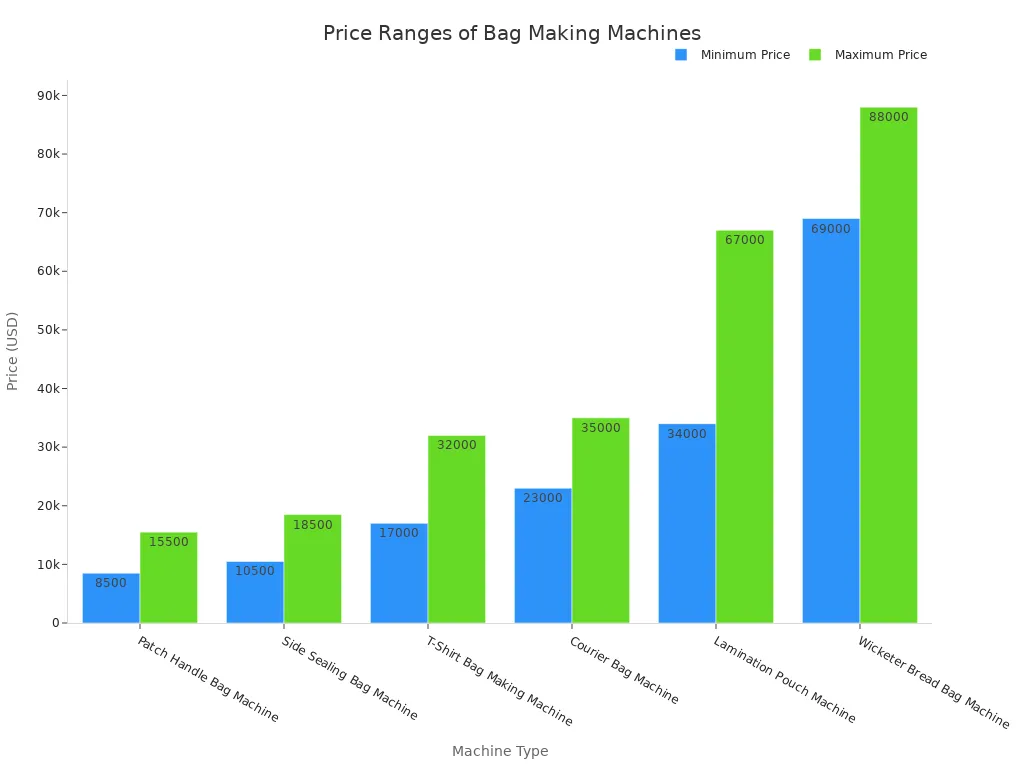
Plastic shopping bag making machine setups vary by bag style. A T-shirt bag making machine usually costs between $17,000 and $32,000. Side sealing bag machines range from $10,500 to $18,500. Courier bag machines run $23,000 to $35,000. Patch handle bag machines cost $8,500 to $15,500. These price ranges show different automation levels and production capacities.
The plastic bag making machine group includes several process steps. Extrusion melts raw resin into film. Printing adds your branding or product info. Cutting and sealing form the final bag shape. You can buy these as separate units or as an integrated line. Integrated lines cut handling time but cost more upfront.
Non-woven shopping bags need a different machine setup. These machines use ultrasonic sealing instead of heat sealing. This method creates stronger seams without melting the fabric. Non-woven machines also include handle attachment parts. You can make die-cut handles or loop handles based on your design.
Paper shopping bags offer another path. The automatic paper bag making machine makes bags for groceries, retail items, and food products. Supermarkets, retail stores, and restaurants often use these machines. The square bottom paper bag making machine creates bags with a flat square base. Bakeries, coffee shops, and food businesses like this style for its steady look.
Paper bag machines split into two feeding methods: roll-fed and sheet-fed. Roll-fed machines take continuous paper rolls. They run at high speed and fit large-volume manufacturing. Sheet-fed machines use pre-cut sheets. They give more flexibility for specialty printing and small batches.
The automatic paper bag making machine handles nearly all operations. You only need to refill raw materials, collect finished products, and enter commands. These machines make medicine paper bags, grocery bags, butter paper bags, and more. They serve both drug and retail sectors.
|
Metric |
Paper Bag Machines |
Plastic Bag Machines |
|---|---|---|
|
Initial machine cost |
$150,000–$500,000 |
$100,000–$400,000 |
|
Installation & training |
$20,000–$50,000 |
$15,000–$40,000 |
|
Production speed |
200–400 bags/min |
500–1,000+ bags/min |
|
Material cost advantage |
15–25% lower than plastic |
Higher |
|
Energy consumption |
30–40% less than plastic |
Higher |
|
5-year operating cost |
20–30% lower |
Higher |
|
Payback period |
18–36 months |
Shorter initial cost |
Specialty setups serve different industries. Valve bag machines form a filling valve for powders and granules. Cement, minerals, and chemical companies use these leak-proof bags. Open mouth bag machines have a top-fill design for grains, fertilizers, and animal feed. Flat bottom machines make sturdy square bases for retail, food, and e-commerce packaging.
Price varies widely across paper machine setups. Semi-automatic machines for flat, satchel, or simple SOS bags cost $2,000 to $15,000. Fully automatic roll-fed machines without handles run $25,000 to $80,000. Roll-fed systems with inline handle units cost $60,000 to $180,000. Fully automatic sheet-fed luxury lines start around $170,000 per setup.
Sustainable packaging trends push more makers toward paper options. Paper machines use 30–40% less energy than plastic ones. Their 5-year operating costs run 20–30% lower. These factors make paper attractive despite higher initial cost. Customization options include bag size, handle type, printing, and sealing methods. You can tailor each machine to your specific product line.
Fully automatic paper bag making machines handle nearly all operations, needing operator help only for raw material refills, product collection, and command entry.
Your material choice also affects sustainability. Biodegradable plastics like PLA and PBAT fit eco-friendly markets. Paper stays the most recyclable option. Think about your target customers and their packaging needs before picking a machine family.
Key Features of a Bag Machine
Once you know the machine types, you need to look at the key features that separate a smart buy from a costly error. Three areas matter most: size, price, and speed. But under those broad areas lie specific engineering details that decide whether your bag making machine gives steady output or constant problems. You should check material compatibility, production speed, automation level, maintenance needs, ease of use, energy efficiency, and safety features before you buy anything.
The automation level you pick directly affects your labor costs and output. Fully automatic bag making machines save about 50–70% of labor costs compared to semi-automatic models. One worker can run several automated machines, which cuts the number of workers you need on the floor. Production rates show the difference clearly: semi-automatic machines make 150–200 bags per minute, while fully automatic units reach 350–400 bags per minute. Monthly labor costs drop from $3,000–$4,000 to $1,200–$1,600 after automation.
However, automation does not remove the need for skilled workers. Operators must understand digital controls, fix mechanical issues, and handle workflow integration. Factories that train their workforce alongside automation get better long-term efficiency and reliability.
The control system itself matters just as much. Servo-driven systems offer micron-level positioning accuracy, which gives you exact control over bag length, sealing position, and cutting accuracy. This precision cuts scrap rates a lot. Mechanical systems lack this level of control, which leads to more variation and waste.
|
Metric |
Servo-Driven System |
Mechanical/Pneumatic System |
|---|---|---|
|
Speed |
Excellent; higher, more controlled, repeatable cycle speeds |
Good but limited by cylinder speed and valve response |
|
Energy Consumption |
Very Low; uses energy 'on-demand' only; can use 70-80% less energy |
Very High; constant air demand and costly leaks |
|
Upfront Cost |
High; significant capital investment |
Low; main appeal is low-cost design |
|
Total Cost of Ownership |
Low; energy savings and high uptime lead to rapid ROI (often 12-24 months) |
High; energy costs and maintenance add up |
|
Maintenance |
Low; no wearable seals or air lines; minimal maintenance |
Medium; involves replacing seals, valves, and finding leaks |
|
Flexibility |
Excellent; all parameters changed via HMI |
Fair; requires mechanical adjustments for speed/position changes |
|
Noise Level |
Very Low |
High (air exhaust) |
Servo-driven systems also give maintenance alerts through the HMI. When a machine axis runs poorly, the system warns you before serious problems happen. This predictive ability cuts downtime and extends equipment life. The automation features of servo systems let you switch between bag types—flat, vest, roll—through parameter changes without complex mechanical adjustments.
Machine size sets your floor space needs and your production capacity. You must match the physical footprint to your facility while making sure the machine can handle your target output. Speed ratings show the maximum potential, but you should figure out realistic daily yields rather than trusting advertised top speeds. Downtime from film roll changes, jam clearing, and maintenance lowers actual throughput.
Durability separates reliable machines from constant repair sources. Check the machine's frame construction for thickness and rigidity. Verify the brands of key parts like motors, PLCs, and sensors to judge reliability. Ask for customer references to confirm real-world performance. Review warranty terms to understand coverage length and conditions. Confirm that spare parts are easy to get for critical wear items.
Maintenance needs directly affect your long-term costs. Daily lubrication of bearings, slides, and gears can cut energy use by 5–10%. Monthly maintenance schedules lead to a 25% drop in unexpected breakdowns. Timely replacement of electrical wiring and hydraulic parts can cut downtime by up to 20%. Proactive troubleshooting and logging incidents can reduce troubleshooting time by 30%.
|
Maintenance Task |
Key Actions |
Purpose |
|---|---|---|
|
Regular Cleaning & Lubrication |
Clean dust/debris; follow lubrication schedule |
Reduce friction and prevent performance degradation |
|
Electrical Inspection |
Check heating elements, motors, sensors for wear |
Prevent downtime and extensive damage |
|
Replace Worn Parts |
Monitor belts, gears, blades; keep spares |
Avoid costly breakdowns and interruptions |
|
Calibration & Alignment |
Adjust bag size, printing, sealing settings |
Ensure consistent quality and minimize waste |
|
Temperature Control Monitoring |
Check heating elements and thermostats |
Prevent sealing/printing defects |
The design of your bag machine should also support customization options. Look for modular upgrades like punching units, gusset formers, or ziplock sliders. These additions let you expand your product line without buying a new machine. The price of these features varies, but they often cost less than replacing equipment later. Evaluate the bagging machine efficiency of each model by asking for real-world throughput data, not just theoretical maximums. A machine that runs reliably at 80% of its rated speed beats one that constantly breaks down at full speed. Your final choice should balance all these factors against your budget and production goals.
Choosing a Bag Making Machine SupplierChoosing the right supplier is just as important as the machine. A reliable supplier keeps your machine running with little downtime. Many buyers only look at the machine price and ignore the supplier's track record. This mistake leads to costly delays and lost production. You need to check the supplier's reputation, certifications, and after-sales support before you commit.
First, check the supplier's certifications. CE certification means the machine meets EU health, safety, and environmental rules. ISO 9001 shows the supplier has a strong quality system for steady product quality. UL certification checks electrical safety and fire resistance for North America. These certifications give you confidence in safety, quality, and market access. A supplier without these credentials is riskier. Choosing a verified supplier protects your investment.
Ask the supplier for customer references, especially from companies like yours. Ask for case studies that show their work with similar jobs. A supplier who gives references shows they are reliable. Look for reviews and comments from other customers. Talk to current users to learn about real performance and support quality. References from other bag machine buyers help you check supplier claims.
After-sales support is key to avoiding costly problems. Businesses without good support see more breakdowns, delays, and lost revenue. When buying a bag machine, focus on the manufacturer's support before the price. Your bag machine depends on the supplier for fast technical help. Confirm the supplier offers on-site training, setup, and remote troubleshooting with response time guarantees.
A standard warranty for bag machines is 12 months after installation or shipment. It covers defects in mechanical parts and electrical systems. The supplier gives replacement parts for confirmed defects. Technical help and troubleshooting support are included. The warranty does not cover damage from bad use, changes, power issues, or wrong film. Read the warranty terms carefully before you sign. A reliable supplier stands behind their promises.
Spare parts availability directly affects long-term reliability. OEM parts guarantee a perfect fit for your machine model. They use consistent high-grade materials and keep original performance. The warranty covers these parts, and you get full technical support. Third-party parts cost less but have uncertain compatibility and variable quality. They may void your original warranty. The risk of lower efficiency and damage makes OEM parts safer for critical parts. Choosing quality and reliability in parts prevents production interruptions.
A good bag making machine supplier keeps a local stock of wear items like blades, belts, and heating elements. Ask about lead times for spare parts and stock for older models. This preparation stops long downtime when a part fails.
Final Decision on Bag Making MachinesYou have reached the final step. You must weigh every factor together: machine size, price, speed, supplier support, and long-term partnership. The cheapest option rarely delivers the best value. A low price often means lower material quality, more downtime, and higher maintenance costs over time. You need to evaluate bag machine performance against your actual production needs, not just the sticker price. Your bag making machine supplier should provide clear warranty terms and spare parts availability.
The trade-offs between cost, quality, and lead time shape your decision. A cheaper bag making machine may save money upfront, but it can increase operational costs through inefficiency and durability issues. A higher investment typically yields better production rates and lower long-term costs.
|
Trade-off Pair |
Key Insight |
Practical Implication |
|---|---|---|
|
Cost vs. Quality |
Lower cost may compromise durability |
Cheaper machines increase maintenance and waste costs |
|
Cost vs. Lead Time |
Expedited production incurs higher costs |
Standard delivery schedules reduce total cost |
|
Quality vs. Lead Time |
Quality requires testing time |
Rushing increases defect risk |
First, analyze your actual output needs. Match machine speed to real demand, not maximum capacity. Second, consider your order size. A high-volume machine strains storage and finances for small orders. Third, conduct pilot runs. Real-world tests reveal performance variations that specifications do not show. Fourth, evaluate waste reduction. A slower machine that produces consistent quality reduces waste and improves lead time reliability.
Around 70% of buyers weigh supplier credibility heavily in their decision. Your bag making machine supplier must demonstrate a strong track record. Check their references and visit existing installations when possible. A reliable bag making machine supplier offers responsive technical support and fast spare parts delivery.
Your bag making machine supplier should support your growth plans. Look for modular architecture that allows phased feature additions without full replacement. Negotiate upgrade agreements that include discounted trade-ins and guaranteed module compatibility. Choose hardened steels for high-volume production or economical, swappable tooling for smaller batches.
Automation integration matters for long-term productivity. Ensure the machine can incorporate inline inspection systems, advanced analytics, and statistical process control. Industry 4.0 readiness includes cloud connectivity, open APIs, and cybersecurity features. Different bag machines offer varying levels of scalability, so compare them against your five-year plan.
Create a checklist based on the earlier sections of this guide. Ask each bag making machine supplier for customer references and case studies. Focus on performance, cost-effectiveness, and after-sales support. The right bag making machine balances all these elements. Your final choice should serve you for years, not just months.
Selecting the right bag making machine is a strategic investment. Your choice must match your production volume, speed requirements, and material compatibility. The decision comes down to three core factors: size, price, and speed. A reliable bag making machine supplier provides strong after-sales support and spare parts availability. Avoid choosing based on cost alone. Evaluate performance and cost-effectiveness together. Consider sustainable packaging trends for future growth. Compare different bag making machines to find the best fit. Create a detailed requirements list now. Contact multiple suppliers with your list. Compare their offerings, request references, and visit existing installations. Focus on after-sales support during your evaluation. This approach ensures you select a bag machine that serves your business for years without unexpected downtime. Make the right decision today.
FAQA bag making machine that gets good care usually works for 10 to 15 years. You can make it last longer by oiling it often, replacing parts on time, and training operators well. Servo-driven machines often last longer than mechanical ones because they have fewer parts that wear out. Ask your bag making machine supplier for maintenance schedules and expected service life data.
Yes, you need operator training for any bag making machine. Fully automatic models need less manual work but still require digital control skills. Your supplier should provide on-site training and setup support. Plan for ongoing skill development. Factories that train workers alongside automation achieve better efficiency and fewer breakdowns.
Some machines handle multiple materials, but you must test compatibility first. Plastic bag making machines process LDPE, HDPE, and PP films. Biodegradable materials like PLA and PBAT need specific settings. Paper bag machines use roll-fed or sheet-fed paper. Switching materials requires recalibration and may slow production. Verify material compatibility before purchase.
Maintenance costs vary by machine type and usage. Daily lubrication cuts energy use by 5–10%. Monthly inspections reduce unexpected breakdowns by 25%. Keep spare parts like blades, belts, and heating elements in stock. OEM parts cost more but guarantee fit and performance. Factor these expenses into your total ownership calculation.
"4mmx2mm Disc Magnet" from S****** received 4 quotation(s)